RetailMeNot / App
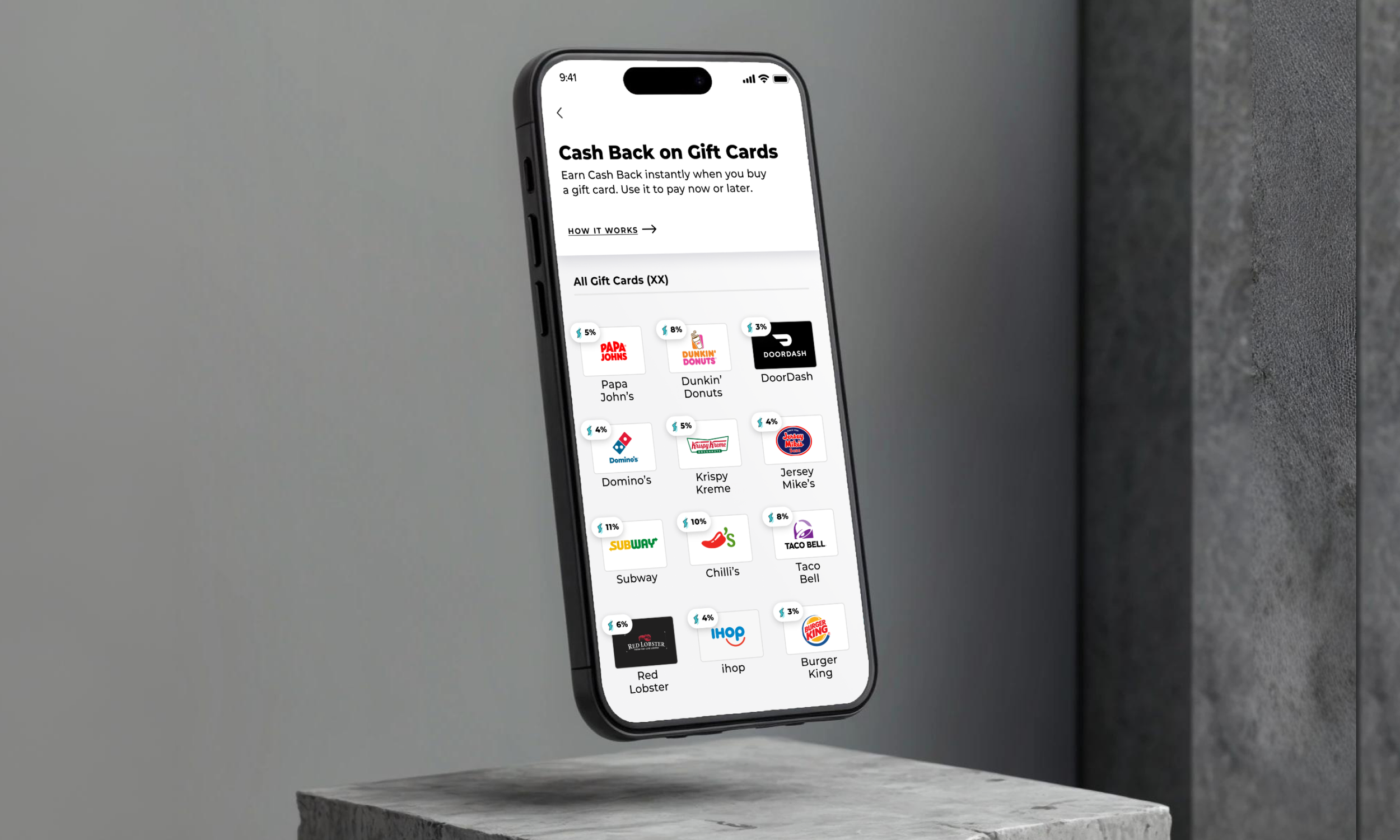
Instant Cash Back on Gift Cards
Led product design across iOS and Android to take a 45-day cash back delay down to zero. The app's stickiest feature, and its highest-AOV segment.
- Role
- Product Design Lead, iOS and Android. Product strategy, user flows, research, and end-to-end design from concept through launch.
- Partners
- Kelsey Loftin, UX Researcher.
- 0 days
- From a 45-day wait
- Highest
- Repeat usage
- iOS + Android
- Launched
Cash back took up to 45 days to reach a user's wallet, which cut the reward loose from the purchase that earned it. Researching the category, I found the constraint was softer than it looked. Gift cards transfer value at the moment of purchase instead of settling through a merchant reconciliation cycle, so cash back could land instantly.
That turned a payments limitation into a design question. I led product design across iOS and Android from that question through launch. The program shipped with a deliberately small feature set and became the stickiest thing in the app.
Problem
How might we bring instant cash back into the RetailMeNot app, and prove it works before we build the whole thing?
Background
The problem
The friction was never the size of the reward. It was the wait. Money that shows up 45 days after checkout has nothing to do with the purchase that earned it. The user has moved on, so the reward reinforces no behavior and pulls nobody back into the app. Delayed cash back is a retention problem dressed as a payments problem. Every deals app in the category lived with it. The delay comes from how merchant reconciliation works, so it read as a fixed cost of doing business rather than something design could touch.
The insight
It was not fixed. Gift cards run on different mechanics. Value transfers at the point of purchase instead of settling downstream, so using them as the cash back mechanism closes the 45-day gap entirely. That reframed the work. We were not shortening a payout timeline. We were changing what the reward was so the timeline stopped applying.
The question
Two things had to be true. The program had to fit inside the existing app without a redesign, and it had to earn its expansion on real usage data rather than internal conviction.
Approach
Phase 1: Competitive analysis
I started with a deep look at deal apps and apps running gift card programs, mapping how the category handled purchase, storage, and redemption.
Phase 2: Mapping the full program
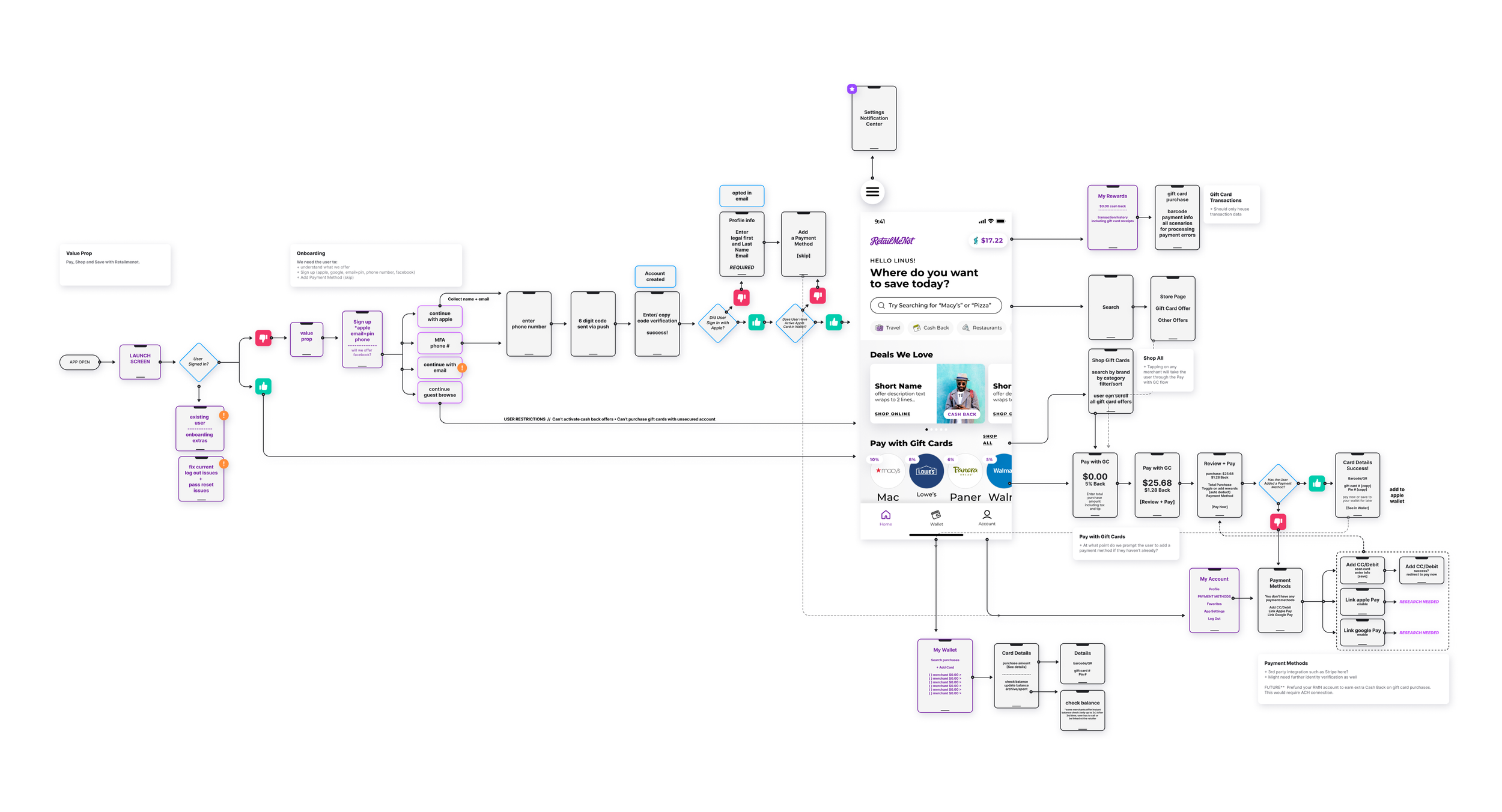
I charted a complete user flow for a full gift card program, including a digital wallet and the ability to spend earned cash back on gift cards. This was the maximal version, built to make the whole opportunity legible before anyone decided what to cut.
Defining the MLP
I presented that full flow and we worked through each feature together. Product and senior leadership chose to cut scope and get a minimum lovable product into production, where real usage could tell us whether the model held up. Mapping the full program first is what made that a strategic decision instead of a guess. Leadership could see exactly what was being deferred and why.
Validating the journey
Kelsey Loftin, our UX Researcher, and I audited every current user journey together. I handled prototyping, auditing, and test writing. We tested the end-to-end flow for friction, and we tested the program messaging just as hard. Instant cash back only works as a differentiator if people understand the offer, so comprehension was a design problem in its own right, not a copy pass at the end.
Designing inside the existing app
The program had to enter the app without redesigning it. I needed to drop a new financial mechanic into established flows without seams. Timing helped. I was building the new RetailMeNot design system in parallel, so extending it with the components this program needed was straightforward rather than disruptive. From there we refined the flow and high-fidelity designs across several rounds of internal and external feedback, most of it driven by scope changes, technical limits we did not see coming, and new requests arriving mid-flight.
Solution
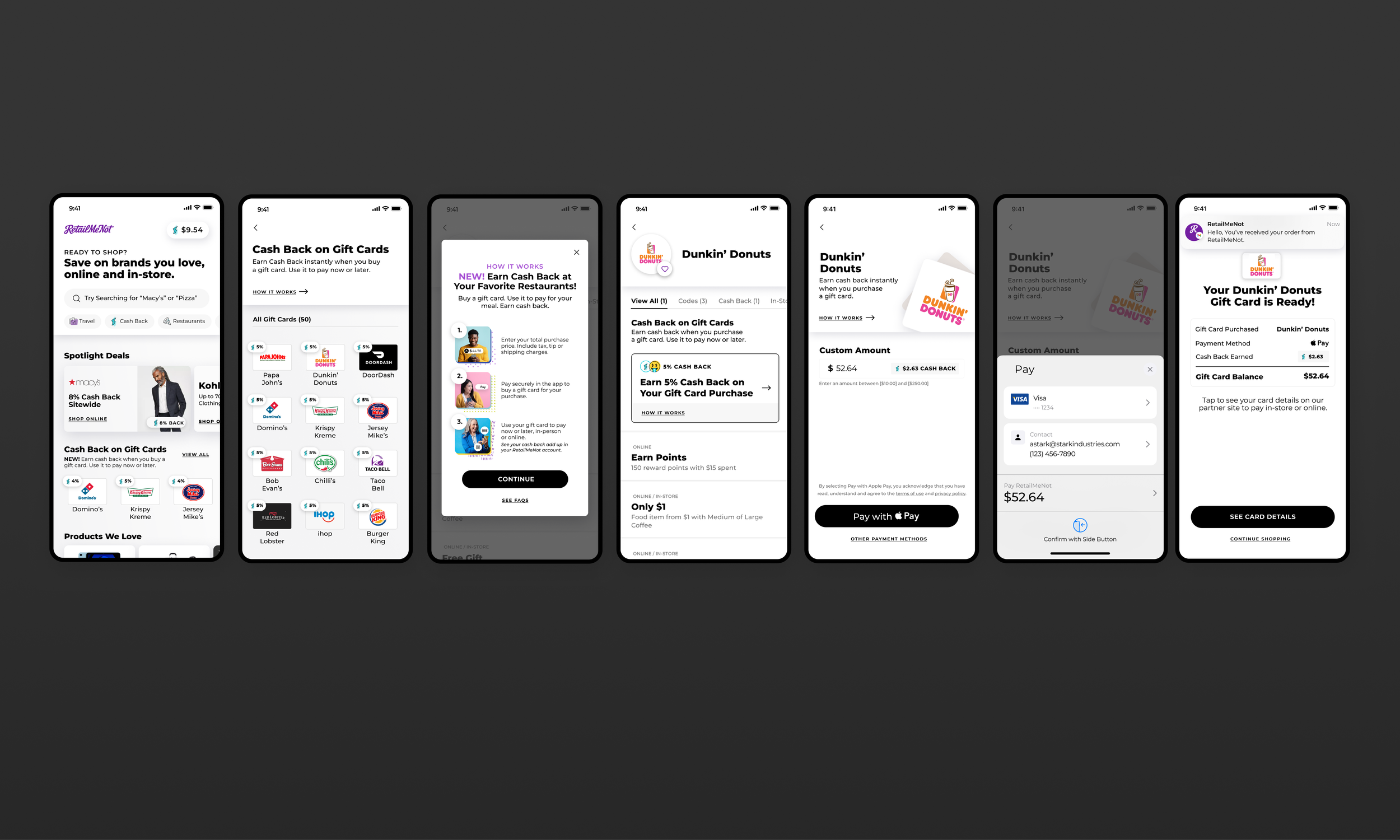
Instant Cash Back on Gift Cards launched on iOS and Android with a small, focused feature set. Users buy a gift card in the app and the cash back hits their wallet immediately instead of 45 days later.
The experience lives inside existing flows rather than beside them, built from components that extend the design system instead of breaking from it. A substantial new financial mechanic reads as a native part of the product, not a bolted-on program.
Outcomes
The stickiest feature in the app to date.
Instant reward turned out to be the most attractive benefit we offer.
Highest repeat usage
Gift card buyers return more often than any other group.
Highest AOV
They also carry the highest average order value of any segment.
Validated for expansion
With viability proven, the program is slated to expand across the app and into web and extension.
Reflection
The most valuable thing I did here was design the version we didn't build.
Charting the full gift card program, wallet and redemption and all, before scoping down meant the MLP conversation was about sequencing rather than sacrifice. Leadership could see the whole picture and pick a starting point inside it. Had I designed straight to the minimum, we would have shipped something smaller and understood far less about where it was going.
Most of this project's success sat in comprehension, not interface.
"Instant" only differentiates if people grasp what is different. Testing the messaging as rigorously as the flow is what kept the value proposition from getting lost in a purchase funnel.
This is the clearest return I have seen on design system investment.
Because I was building RetailMeNot's system in parallel, introducing a brand new financial mechanic meant extending a vocabulary we already had rather than negotiating a new one. That is the argument for design systems that spreadsheets never quite capture.